
In this article, the focus is on baby crying, which can sometimes be intense and is understood as an attempt to regulate the child. In addition, baby crying is outlined in the context of regulatory crises, in which parent-child interaction is of particular importance. Finally, reference is made to early interventions in parent counseling and baby and parent psychotherapy to show that interventions can help both babies and their caregivers to understand and alleviate moments of crisis.
Ability to self-regulate
In the first three months of a baby's life, an increased tendency to restlessness can be attributed to age-specific adaptation and maturation processes. The baby faces the challenge of getting to know and adapting to basic physical processes, such as feeding and digestion, regulating its body temperature and regulating and organizing its behavioral states.1 It is therefore very understandable that the first twelve weeks of a baby's life can be accompanied by increased whining, crying and perhaps even screaming. The baby needs time to adjust to life outside the womb. Besides the fact that crying is part of a baby's overall world language and allows him/her to communicate body states, needs and emotions to the environment and interact with it, it also helps to relieve stress.2 Baby crying also has a strong stimulating character. The baby is trying to communicate and show that it needs the other person to satisfy an urgent need.
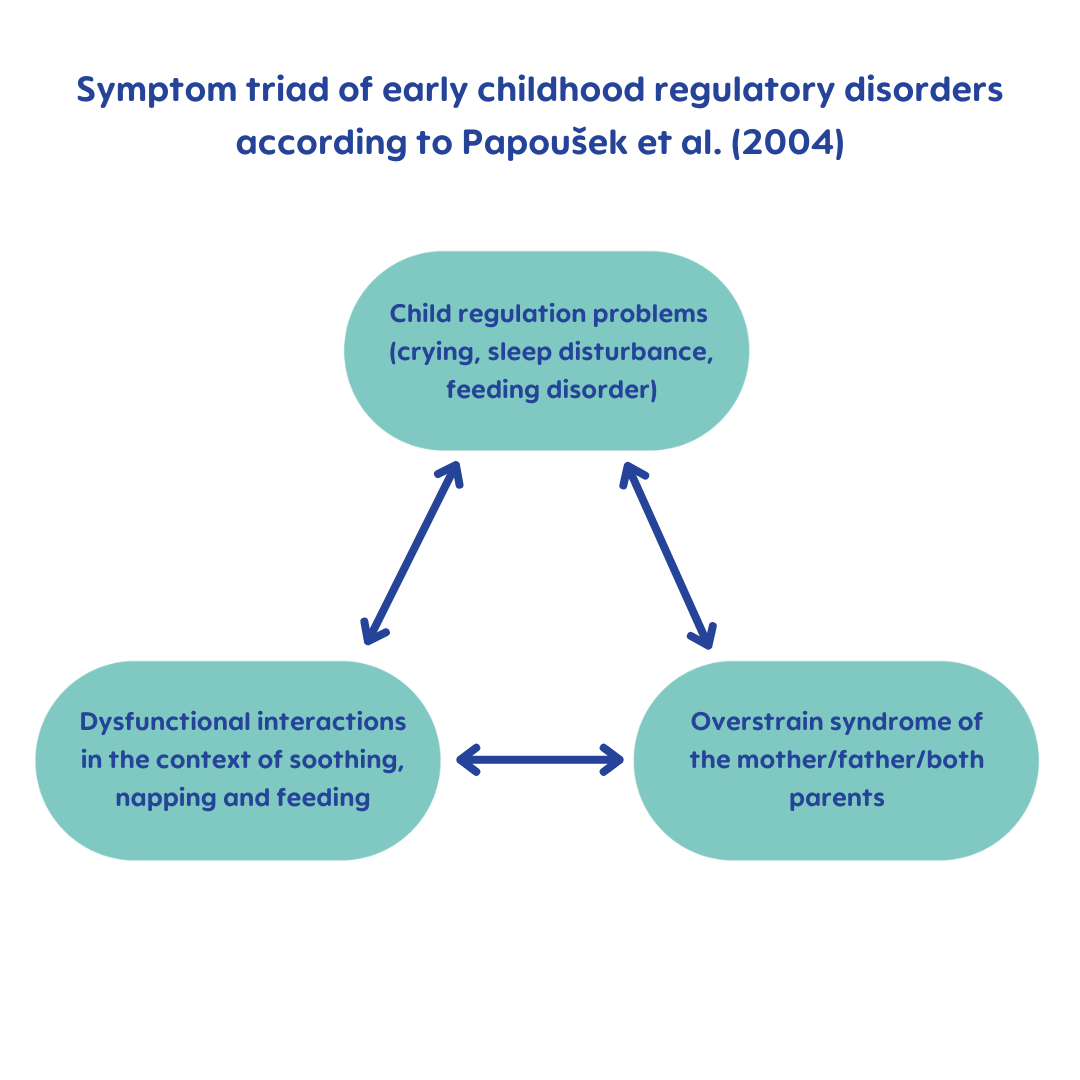
Symptom triad of early childhood regulatory disorders according to Papoušek et al. (2004) 6
This means that early childhood regulatory disorders are not just a disorder of the baby, but a symptom triad of child behavioral problems, severe current or chronic excessive demands on the parents and stressful factors in the parent-child relationship and interaction (in the affected regulatory areas). This can negatively influence or even threaten the relationship between the child and its parents and thus the child's further development. In the worst case, dysregulated child behavior, difficulties with affect and self-regulation and an increased risk of maltreatment can result in babies who cry excessively and parents who feel overwhelmed, desperate and above all helpless.
Clinical studies indicate that babies who cry excessively and are difficult to soothe are in many cases highly stressed by psychosocial risk factors both pre- and postnatally.1 Prolonged stress and intense anxiety during pregnancy, unresolved couple conflicts or conflicts within the family, events such as serious illnesses, deaths, unexpected prenatal diagnostic results, previous miscarriages, as well as stressful experiences and complications during and after birth (separation of parents and child), pre- and postnatal depression in mothers and fathers are understood to be associated with increased crying in babies.
Conclusion
Parental counseling and psychotherapy can therefore be very relieving and allow parents who constantly offer their babies co-regulatory support a space for their own feelings. After all, parents also go through processes of change and adaptation in their role as parents and as a couple, which are challenging and also require time. Furthermore, as already mentioned, in a counseling context, parents can work out ways to offer reassurance and relief to both their baby and themselves.
Published 07/2024

List of sources
1 Cierpka, M. (2012): Early childhood 0-3. Counseling and psychotherapy for parents with infants and toddlers. Springer-Verlag: Heidelberg.
2 Harms, T. (2021): Don't be afraid of baby tears. How to accompany your baby's crying safely through mindfulness. Psychosozial-Verlag: Giessen. 3rd edition.
3 Sonn-Rankl, C. (2021): How to calm my baby. Patmos-Verlag: Ostfildern.14th edition.
4 Wessel et al (1954): Paroxysmal fussing in infancy, sometimes called "colic". In: Pediatrics, 14, 421-435.
5 Papoušek, M. (1985): Observations on the triggering of crying episodes in early infancy. In: Offprint from Sozialpädiatrie in Praxis und Klinik, 6:9, 517-526.
6 Papoušek, M. (2004): Regulatory disorders in early childhood. Family physician counseling for crying, sleeping and feeding disorders? In: MMW Fortschritte der Medizin, 147, 12:4, 32-38.
7 Harms, T. (2016): Emotional first aid. Attachment support - crisis intervention - parent-baby therapy. Psychosozial-Verlag: Giessen. 2nd edition.